Myths – History
Kythira, the birthplace of Aphrodite
Greece’s forgotten island only reveals its charm upon closer inspection. An island for explorers, for what it has to offer is not immediately obvious. Kythira is also the island of Aphrodite; here – not in Cyprus , as some skeptics claim – in a bay in the southeast, the “foam-born” goddess is said to have risen from the sea. Whether Kythira or Cyprus, everyone can decide for themselves. Even experts disagree on the true birthplace of the goddess of love, but when you stand in the bay of Paleopoli , the decision is easy…
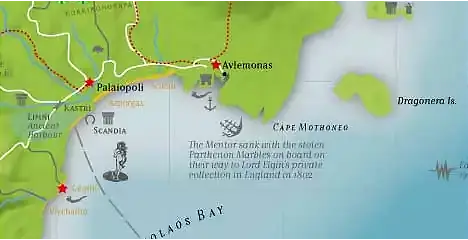
Legend has it that Aphrodite, the goddess of love , rose from the sea on Kythira (and not Cyprus). A gruesome event once took place here, on the island’s southeast coast: Cronus, king of the Titans, was filled with rage against his brutal father Uranus, so much so that he cut off Uranus’s genitals with a sickle and threw them into the sea. Uranus’s blood turned to foam, and from that foam arose Aphrodite, the “foam-born.” The only remaining evidence of this event today are two small rocks in the sea near Paleopoli, commemorating Uranus’s agonizing death…
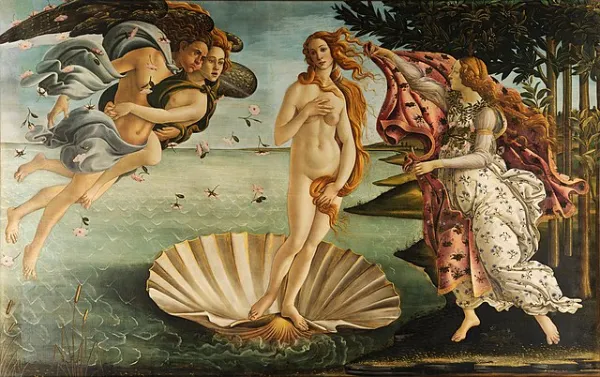
Myths abound surrounding Aphrodite and her escapades . She was said to be mocking, sensual, and beautiful, and not averse to mortals. She cuckolded her husband Hephaestus and had affairs with Ares, Hermes, and Adonis—Aphrodite could win over all the gods. The most famous myth, however, is that of Aphrodite and Paris: At a wedding attended by Hera, Athena, and Aphrodite, Paris was to present a golden apple inscribed “To the Fairest” to the woman who “deserved” the title. Bribery was not a foreign concept in antiquity either, and Aphrodite – not only beautiful but also clever – was able to make Paris the most tempting offer of all, thus outmaneuvering her rivals Hera and Athena: if she received the apple, she could unite Paris with the truly most beautiful woman in the world – even paradox had its firm roots in antiquity. The chosen goddess of love kept her word and actively helped Paris abduct the not averse ” Beautiful Helen ,” which ultimately led to the outbreak of the Trojan War .
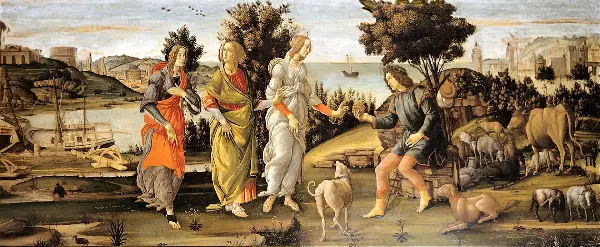
A statue of Paris shows him offering an object – presumably an apple – to Aphrodite with his outstretched hand.
Paris, the “Beautiful Helen” and the Sempreviva
The myth says that the two stopped in Kythira on their journey to Troy to pay homage to the goddess Aphrodite, as they were under her personal protection. When the beautiful Helen noticed Aphrodite’s beauty, she became jealous and tried to force Paris to declare her the most beautiful woman in the world.
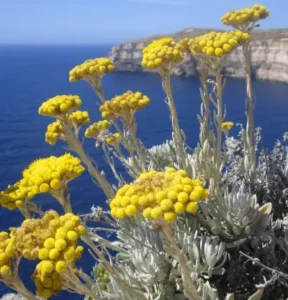
Paris, wanting to calm Helen, showed her a yellow flower and said, “Do you see this flower?” He added, “Your hair has its golden color, your body is as delicate as its stem, and your skin is as soft and velvety as its petals. Your beauty is eternal, like that of the flower.” The flower was called Sempreviva.
Kythira in the romanticized view
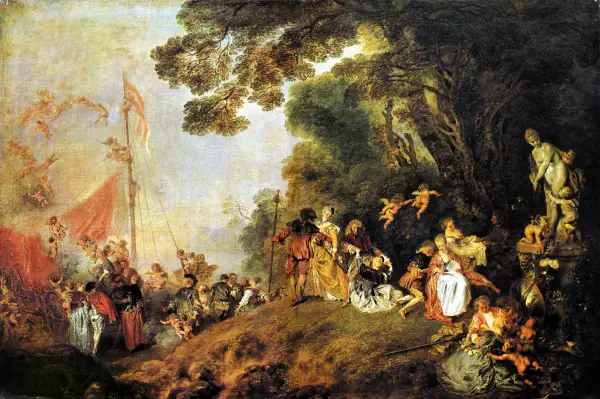
In the 18th century, the island of Kythira was considered a realm of love, far removed from all conflict. “The Embarkation for Cythera ” (French: Pèlerinage à l’île de Cythère) is the title of three paintings by the French painter Jean-Antoine Watteau .
It is the place where, according to mythology, Aphrodite is said to have risen from the sea foam. It was precisely at this spot that numerous lovers gathered.
The French writer Charles Baudelaire immortalized the island in his poem “ Un Voyage à Cythère ”.
When the French navigator Louis Antoine de Bougainville captured Tahiti for the French from April 6 to 15, 1768, he named the island “Île de la Nouvelle Cythère” (New Cythira).
“One world creates another world, and Kythira is another world , ”
the Venetians said when they spoke of Kythira.
History
The oldest finds indicate that the island was settled as early as the 3rd millennium BC. During the Minoan period, connections existed between Kythira and Crete; the island was likely a stopover on the Minoans ‘ sea route westward. Kythira was also inhabited during Mycenaean times. Thanks to its favorable location between east and west, the island was of great interest to the Phoenicians from around the 9th/8th century BC, not least because of the abundant murex snails, which were fished from the sea and used to obtain the precious dye (e.g., for coloring royal robes). At this time, the island was also known as ” Porphyrusa ,” the “Purple Island.”
From the 6th century BC onwards, with the Spartans’ conquest of the island, Kythira’s history became highly turbulent. Strategically located, it was a bone of contention between the two superpowers, Athens and Sparta, until the end of the Peloponnesian War (431-404 BC) and Athens’ subsequent defeat. This led to a decline in Athens’ interest in the island, and Sparta’s campaign against their former allies, the Persians. After a brief Macedonian interlude, the Romans ruled the island from the 1st century BC until the Byzantines inherited the legacy of the Roman Empire in 395 AD. By this time, however, Kythira had long since faded into insignificance.
After a long period of decline, Kythira was placed under the control of the then very powerful Monemvasia in the 12th century AD, and soon after (1207 AD) handed over to the Venetian Veneris family. During this period, the then capital, Paeochora, was founded . In 1537, it was razed to the ground by the pirate and Turkish admiral Hayreddin Barbarossa ; two further raids followed. Nevertheless, the island remained—interrupted by a three-year Turkish occupation—in the hands of the great power Venice until 1797. From then on, Kythira’s history mirrors that of the other Ionian Islands: in 1797 the French arrived , and just a year later the Russians took control. Armed forces gained the upper hand, and in 1800 the Ionian Republic was proclaimed. A brief interlude by Napoleonic troops followed in 1807, until finally, in 1809, the English raised their flag on the island. The most visible evidence of the 55 years of English rule is certainly the “English Bridge” near Katouni, the first school near Livadi, and the extensive road network. The Ionian Islands were finally incorporated into Greece in 1864.
In the 20th century, Kythira experienced a significant wave of emigration: most of those who left their island went to America and later, especially after the Second World War, primarily to Australia . The number of immigrants of Kytheran origin in Australia is estimated at around 60,000, while only about 3,000 permanent residents remain on the island itself.
Myths and history