Attractions – Things to see
The Agia Sofia Cave
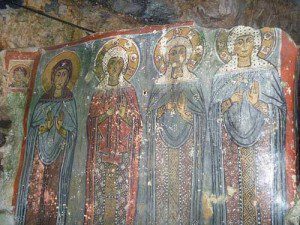
Attractions – The Cave of Agia (Saint) Sofia is one of three known caves in the vicinity of Kythera. The other two, also known as the Caves of Agia Sofia, are located in Kalamos and Agia Pelagia. However, this cave is much more interesting and the only one that has been explored. The Cave of Agia Sofia served as a church for over 800 years. According to mythology and more recent research, Paris and the beautiful Helen of Troy hid here. Mythology claims they were married in the cave’s entrance. The Cave of Agia Sofia is now widely recognized as one of the world’s most mythological caves. Many scientists have attempted to explore the cave. In 1930, the Kytherian speleologist Ioannis Petrochilos made the first systematic attempt to penetrate the cave’s interior. Finally, in 1970, his wife, Anna Petrochilou, created an analytical map of the cave’s interior. The cave covers an area of 2200 square meters and stretches 500 meters from entrance to exit, with a 200-meter-long tourist route. The cave is 60 meters above sea level and 20 meters deep. Inside, visitors can see various stalactite and stalagmite formations in colors ranging from white to black and various shades of red. These diverse colors are a result of the region’s metallic components and chemical composition.
The Moudari Lighthouse
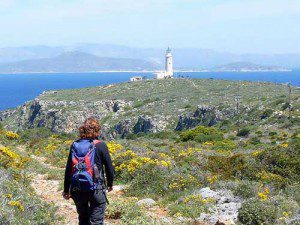
Attractions – It’s the lighthouse at the northernmost point of the island, at Cape Spathi. It’s the largest lighthouse built under British rule. Constructed in 1857, it stands 25 meters tall. The view of the strait from the lighthouse is breathtaking.
Chousti’s Cave
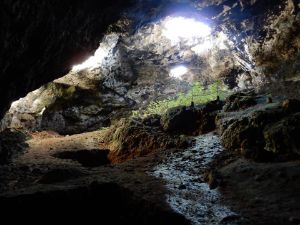
The Chousti cave was only recently excavated. Archaeologists discovered pottery and human fossils from the Mesolithic period, around 3000 BC. It is believed that the cave was used as a shelter. It is located near Diakofti.
The Monastery of Myrtidia
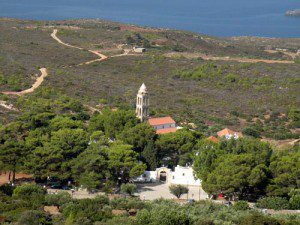
Located in the southwestern part of Kythera is the Monastery of Panagia Myrtidiotissa, the island’s religious center. Twice a year, on August 15th and September 24th, the Virgin Mary is venerated by locals and many visitors. The road to the monastery leads over a stone bridge dating from 1821 and through an impressive rock arch, descending gradually to the sea. From the large cross just before the monastery, visitors are rewarded with a magnificent view of the monastery and the sea beyond.
The bridge of Katouni
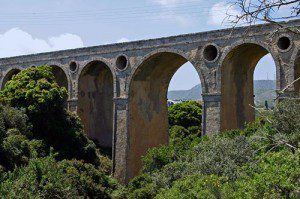
Built in 1826, it is the largest stone bridge in the Balkans constructed by the British (110m long, 6m wide, 15m maximum height, and supported by 13 arches and 12 symmetrical galleries). Legend has it that the British Commissioner Mackwell was in love with a young local sorceress and had this bridge built to make it easier for him to visit her.
The Cave of Chytra
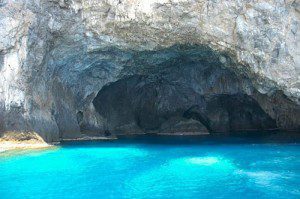
Attractions – A few nautical miles outside Kapsali Bay lies the rocky island of Kythira, an almost inaccessible island and an ideal breeding ground for birds. On the island’s south side, there is a cave that can be visited by Captain Spiros’s excursion boat. The small blue cave of Kythira is a must-see! On the island’s steep slopes grows a rare yellow flower, the Sempreviva (the eternal life). This flower is harvested only by experienced locals in June.
The Tsakonas Gorge
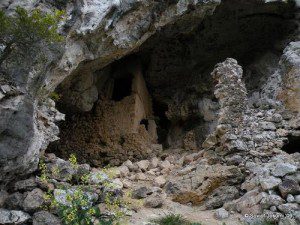
The Tsakonas Gorge is located between the villages of Mitata and Viaradika, in the center of the island. It’s a very challenging but fascinating gorge due to its diverse flora. Even more intriguing are the hidden churches carved into the rocks within the gorge.
The Mylopotamos Waterfall
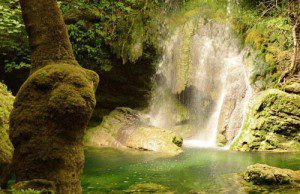
Attractions – In the picturesque village of Mylopotamos, follow the signs for “Neraida Waterfall” or the M41 hiking trail. The water plunges from a height of about 20 meters into a small pool. An idyllic spot with lush vegetation. Hike along the stream, which leads you deeper into the gorge, past abandoned watermills with their small lakes and cascades, and past small, old stone bridges and mills. A path that takes you back in time and evokes memories of fairy tales.
Paleochora
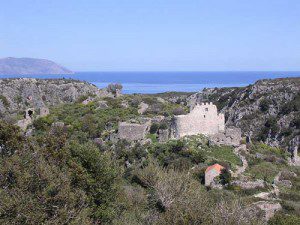
Attractions – Paleochora, also known as Agios Dimitrios, was the Byzantine capital of the island. It is located in the northernmost part of the island, perched on a steep cliff at the confluence of two ravines. There, the islanders had found refuge from pirates. The city’s position was ideal, impregnable from the sea. In 1537, the pirate Barbarossa conquered the city from the land side and killed 7,000 people. Today, the ruined city possesses a wild, eerie charm. Magnificent frescoes adorn the walls of some of the ruins. A beautiful hiking trail, M31, starts in Potamos and leads via Trifilianika to Paleochora. Don’t miss the chance to visit Paleochora!
Byzantine Museum
The Byzantine Museum is located in Kato Livadi. Visitors can view artworks from the Byzantine and post-Byzantine periods, such as murals and objects related to religious rituals. One of the most important exhibits is the collection of fragments from the early Christian period of the Church of Agios Ioannis in Potamos. The museum is open daily except Mondays, and a guide is always available to answer your questions.
Archaeological Museum in Chora
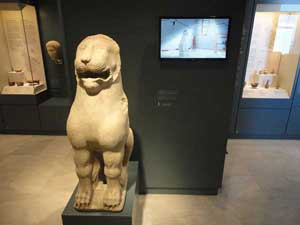
The archaic lion has a remarkable history. It originally came from Paleokastro, the ancient capital of Kythira from around 600 BC to 100 AD. The Venetians brought it to the entrance of the fortress of Chora. During the German occupation in World War II, it was taken to Berlin. By a stroke of luck, a local resident discovered the lion in an archive in Berlin, making it possible to arrange its return to Kythira.
Chora Castle
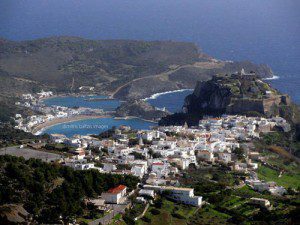
Attractions – The Venetian castle, or “Fortezza,” a 13th-century fortress, stands imposingly above the capital, Chora. Its location, between the Aegean, Ionian, and Cretan Seas, was strategically important. It was also called the “Eye of Crete” because it allowed for the control of shipping movements. Passing renovated old houses, we climb up a cobblestone path to the castle. In the past, access was only possible through the “Fossa,” the tunnel. On the left, you can see the prison, and on the right, the old cisterns. The view from the castle over Kapsali, and on a clear day, all the way to Crete, is breathtaking.